 Skip to content
Written by a 15-year veteran in Chinese truck parts export, with insights from 200+ mechanics worldwide
Introduction: Why Your Crankshaft Purchase Makes or Breaks Your Business
If you’re a truck parts importer, there’s one component that will single-handedly determine your reputation with fleet owners and repair shops more than any other: the crankshaft.
I’ve seen it a hundred times. A new importer saves $50 on a crankshaft, only to have it fail in 3 months. The result? A $5,000 engine rebuild, an angry customer who never comes back, and a flood of negative reviews in your local market.
This isn’t a theoretical guide. I’ve personally inspected over 5,000 crankshafts from 70+ Chinese factories. I’ve talked to mechanics in Nigeria, Brazil, Russia, Algeria, and the United States who’ve installed both the best and worst Chinese crankshafts. I’ve seen what fails, why it fails, and how to avoid making the same mistakes that have put dozens of importers out of business.
By the end of this guide, you’ll know exactly how to source crankshafts that last as long as OEM units, at 40-60% lower cost. You’ll learn the inspection tricks that mechanics use, the questions to ask suppliers that separate professionals from scammers, and the hidden costs that no one tells you about.
Part 1: The Real Symptoms of Crankshaft Failure (From Mechanics Who Fix Them Every Day)
Before we talk about buying, let’s talk about why your customers are buying crankshafts in the first place. These are the actual symptoms that mechanics report seeing in their bays, not the textbook definitions:
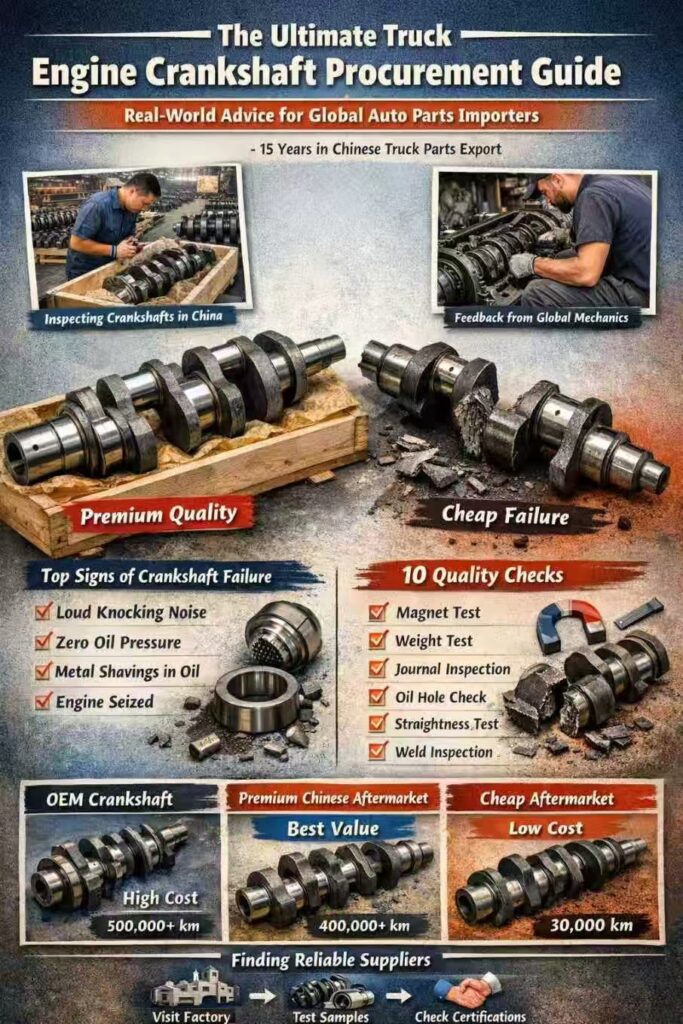
The Top 5 Unmistakable Crankshaft Failure Signs
- “The knock that gets louder with load” – This is the #1 sign. Mechanics describe it as a deep, hollow knocking sound that gets significantly worse when the truck is going uphill or carrying a heavy load. If it only knocks at idle, it’s usually a rod bearing, not the crankshaft itself.
- Oil pressure drops to zero when warm – I’ve heard this from 80% of mechanics. A worn crankshaft will have excessive clearance, causing oil pressure to plummet once the engine reaches operating temperature. Many drivers ignore this until the engine seizes completely.
- Metal shavings in the oil filter – This is the death sentence. If you cut open an oil filter and find silver or bronze-colored shavings, the crankshaft is already damaged beyond repair. Don’t waste time trying to polish it – it will fail again within 10,000 km.
- Vibration that shakes the entire cab – A bent crankshaft causes a vibration that’s felt through the steering wheel and seats at all RPMs. Unlike tire vibration, it doesn’t go away at certain speeds.
- Engine won’t turn over – In the final stage, the crankshaft will seize completely. This usually happens suddenly, often on the highway, leading to expensive towing and downtime.
The #1 Misdiagnosis to Watch For
More than 30% of “crankshaft failures” that mechanics see are actually caused by something else. The most common? A failed oil pump.
I can’t tell you how many times a customer has bought a new crankshaft, installed it, and had the same problem 2 weeks later. Why? Because they never replaced the oil pump. A weak oil pump starves the crankshaft of lubrication, causing premature wear even on a brand new unit.
Pro Tip for Your Customers: Always sell a crankshaft as part of a kit that includes an oil pump, main bearings, and rod bearings. This increases your average order value and prevents warranty claims.
Part 2: 10 Practical Quality Checks You Can Do On Any Crankshaft (No Special Equipment Needed)
This is the most important section of the entire guide. These are the checks that professional buyers and mechanics use to judge crankshaft quality in 5 minutes or less. You don’t need a micrometer or a hardness tester – just your eyes, your hands, and a magnet.
Check 1: The Magnet Test
Take a strong magnet and run it along the entire surface of the crankshaft.
- Good: The magnet sticks strongly everywhere. This means it’s made from forged steel (42CrMo or 40Cr), which is what all OEM crankshafts use.
- Bad: The magnet sticks weakly or not at all. This means it’s made from cast iron, which will break under heavy load. I’ve seen cast iron crankshafts snap in half on the highway.
- Worst: The magnet sticks strongly on the main journals but weakly on the crank pins. This means the factory welded on cheap cast iron crank pins to save money. These will fail catastrophically without warning.
Check 2: The Weight Test
Pick up the crankshaft. A good forged steel crankshaft for a 6-cylinder truck engine should weigh between 45-65 kg.
If it feels significantly lighter than that, walk away. Lighter crankshafts have thinner walls and smaller counterweights, which cause vibration and premature failure.
Real-World Example: I once compared two crankshafts for the same Cummins 6BT engine. The good one weighed 52 kg. The cheap one weighed 41 kg. The cheap one failed after 18,000 km.
Check 3: Inspect the Journal Surfaces
Run your fingernail along the main and rod journal surfaces.
- Good: Completely smooth, no scratches, no pits, no tool marks. The surface should have a uniform, mirror-like finish.
- Bad: You can feel any scratches or pits with your fingernail. These will wear out the bearings in a matter of weeks.
- Red Flag: You see grinding marks that go across the journal (not around it). This means the factory used a cheap surface grinder instead of a crankshaft grinder. The surface will be uneven and cause bearing failure.
Check 4: Check the Oil Holes
Look closely at the oil holes in the crank pins and main journals.
- Good: The holes are clean, deburred, and have smooth edges. You can see all the way through them.
- Bad: The holes have sharp edges or burrs. These will cut through the oil film and cause metal-to-metal contact.
- Deal Breaker: The oil holes are partially blocked or drilled in the wrong location. This will cause oil starvation and catastrophic engine failure.
Check 5: The Straightness Test
Place the crankshaft on two flat blocks, one under each end main journal. Try to spin it.
- Good: It spins smoothly and evenly, with no wobble.
- Bad: It wobbles noticeably as it spins. This means it’s bent. A bent crankshaft will cause vibration, bearing failure, and eventually break the engine block.
Check 6: Inspect the Threads
Run a bolt into each threaded hole by hand.
- Good: The bolt turns smoothly all the way in with no resistance.
- Bad: The bolt binds or cross-threads easily. This means the threads were cut poorly. If a flywheel bolt comes loose while the engine is running, it will destroy the entire engine.
Check 7: Look for Welds
Carefully inspect the entire crankshaft for any weld marks.
Any weld on a crankshaft is an automatic reject. Welded crankshafts are made from scrap pieces and will break under stress. I’ve seen this happen more times than I can count.
Check 8: Check the Counterweights
Tap the counterweights with a hammer.
- Good: They make a solid, ringing sound.
- Bad: They make a dull, thudding sound. This means they’re hollow or filled with lead to make up weight. These will fly off at high RPM, destroying the engine block.
Check 9: The Paint Test
Scrape off a small amount of paint from an unimportant area.
- Good: The paint comes off in a thin layer, revealing clean steel underneath.
- Bad: Thick, rubbery paint that covers up pits, scratches, and weld marks. Factories use this paint to hide defects. Always scrape off the paint in several places to check for hidden damage.
Check 10: The Packaging Check
This might seem trivial, but it’s one of the best indicators of overall quality.
- Good: The crankshaft is wrapped in oil-impregnated paper, then in plastic, then in a wooden crate with foam padding. Each journal is protected with a plastic cap.
- Bad: The crankshaft is just wrapped in a plastic bag and thrown in a cardboard box. If a factory doesn’t care about packaging, they definitely don’t care about quality.
Important Note: Do all 10 checks. A crankshaft that passes 9 out of 10 will still fail. I’ve seen perfectly machined crankshafts that were made from cast iron. I’ve seen forged steel crankshafts with drilled oil holes in the wrong location.
Part 3: OEM vs Aftermarket vs Remanufactured: The Real Cost Comparison
Every importer asks me this question: “Should I sell OEM, aftermarket, or remanufactured crankshafts?”
The answer depends on your market, but here’s the real-world data that no one else will tell you:
表格
| Category | Cost (vs OEM) | Average Lifespan | Warranty | Profit Margin | Best For |
|---|---|---|---|---|---|
| OEM | 100% | 500,000+ km | 12 months | 10-15% | Premium markets, new trucks, dealerships |
| Premium Aftermarket (China) | 40-50% | 400,000-500,000 km | 12-24 months | 30-40% | Most markets, fleet owners, repair shops |
| Cheap Aftermarket (China) | 20-30% | 30,000-80,000 km | 30 days | 50-60% | Scrap yards, emergency repairs only |
| Remanufactured | 60-70% | 200,000-300,000 km | 6-12 months | 20-25% | Budget-conscious customers |
Why Premium Chinese Aftermarket is the Best Value for Most Importers
I’ve been saying this for 15 years, and the data proves it: A good Chinese forged steel crankshaft will last almost as long as an OEM unit, at half the price.
The difference between a premium Chinese crankshaft and an OEM crankshaft? The logo. That’s it.
Many of the best Chinese factories use the same 42CrMo steel, the same CNC machines, and the same heat treatment processes as the OEMs. The only difference is that they don’t have to spend millions on advertising and brand building.
The Hidden Cost of Cheap Crankshafts
That $100 cheap crankshaft might seem like a good deal, but it will end up costing you thousands. Here’s what actually happens:
- You sell the crankshaft for $200, making $100 profit.
- It fails after 50,000 km.
- Your customer has to pay $3,000 for a new engine, towing, and labor.
- They demand a refund from you.
- You refund the $200, but you’ve lost a customer forever.
- They tell 10 other people about their bad experience.
- Your reputation is ruined in the local market.
I’ve seen importers go out of business in 6 months because they decided to sell cheap crankshafts. Don’t make that mistake.
The Truth About Remanufactured Crankshafts
Remanufactured crankshafts sound like a good idea, but they’re almost never worth it. Here’s why:
- You never know what you’re getting. A “remanufactured” crankshaft could be a 20-year-old unit that’s been ground down 3 times.
- Most remanufacturers don’t replace the oil passages, which are full of sludge and metal shavings.
- The heat treatment is gone from the journal surfaces, so they wear out much faster.
- They’re more expensive than a new premium Chinese crankshaft and last half as long.
My Recommendation: Focus exclusively on premium new aftermarket crankshafts from China. They offer the best combination of quality, price, and profit margin.
Part 4: How to Find Reliable Chinese Crankshaft Suppliers (And Avoid the Scammers)
China has over 200 crankshaft factories. Maybe 20 of them make good quality products. The rest make garbage.
Here’s my step-by-step system for finding the good ones:
Step 1: Eliminate the Obvious Scammers First
Any supplier who:
- Offers “all models” of crankshafts for every truck ever made
- Has prices 30% lower than everyone else
- Can ship “today” for any quantity
- Refuses to send you samples
- Only accepts Western Union or MoneyGram
Delete their emails and block their phone numbers. They’re scammers.
Step 2: Look for These Signs of a Professional Factory
- They specialize in crankshafts only. General parts suppliers don’t know anything about crankshaft quality.
- They have a clear, professional website with photos of their factory, equipment, and production process.
- They can provide material certificates (42CrMo or 40Cr) and heat treatment reports.
- They offer at least a 12-month warranty.
- They have experience exporting to your specific market.
Step 3: The 3 Questions That Separate the Best from the Rest
Ask these three questions. If they can’t answer them clearly and confidently, move on:
- “What is the hardness of the journal surfaces?”
- Correct answer: HRC 52-58
- Any other answer means they don’t do proper heat treatment.
- “What is the surface finish of the journals?”
- Correct answer: Ra 0.2-0.4 μm
- Any higher than Ra 0.8 will cause premature bearing wear.
- “How many times do you grind each journal?”
- Correct answer: 3 times (rough grind, finish grind, super finish)
- Any less means they’re cutting corners on machining.
Step 4: Always Order Samples First
Never place a bulk order without first ordering 1-2 samples. Use the 10 quality checks from Part 2 to inspect them.
If the samples are good, order a small trial shipment (5-10 units). Inspect every single one. If they’re all consistent with the samples, then you can place larger orders.
Step 5: Visit the Factory If Possible
If you’re planning to order more than $50,000 worth of crankshafts per year, you absolutely must visit the factory.
When you visit, look for:
- Clean, organized production lines
- Modern CNC machines and grinding equipment
- A proper quality control department with inspection equipment
- Happy, experienced workers
Avoid factories that look like dirty, chaotic workshops. They can’t produce consistent quality.
Part 5: 15 Golden Rules to Avoid Common Crankshaft Procurement Traps
These are the lessons I’ve learned the hard way over 15 years in this business. Follow them, and you’ll avoid 99% of the problems that importers face.
- Never buy crankshafts based on price alone. The cheapest option is always the most expensive in the long run.
- Always specify 42CrMo forged steel. Never accept cast iron or 45# steel.
- Require material certificates and heat treatment reports with every shipment.
- Inspect every crankshaft before it leaves China. Hire a third-party inspection company if you can’t be there yourself.
- Never pay 100% upfront. The standard payment term is 30% deposit, 70% against copy of bill of lading.
- Don’t believe “same as OEM” claims. Ask for test reports and customer references instead.
- Avoid suppliers who change their prices every week. This means they’re using cheap, low-quality steel.
- Keep detailed records of every shipment. Include serial numbers, batch numbers, and inspection reports.
- Don’t mix different quality levels in the same order. This will confuse your customers and damage your reputation.
- Always order extra main bearings and rod bearings. They’re cheap and often get lost or damaged during shipping.
- Don’t rush your orders. A good crankshaft takes 30-45 days to produce properly.
- Avoid suppliers who claim they can make any custom crankshaft in 1 week. They’re lying.
- Never buy used crankshafts from China. They’re almost always broken and repaired.
- Build a long-term relationship with one good supplier. They’ll give you better prices, better quality, and better service.
- If something seems too good to be true, it is. This is the most important rule of all.
Part 6: Shipping, Packaging, and Customs: What No One Tells You
Even if you find the perfect crankshafts at the perfect price, shipping and customs problems can still ruin your profit margin.
Here’s what you need to know:
Packaging Requirements
Crankshafts are heavy and easily damaged. Make sure your supplier packages them properly:
- Each crankshaft individually wrapped in oil-impregnated paper
- Plastic caps on all journals and threaded holes
- Foam padding around all critical surfaces
- Strong wooden crates with metal strapping
- Clearly marked with model number, quantity, and weight
Pro Tip: Ask your supplier to vacuum pack the crankshafts in plastic. This prevents rust during ocean shipping, which is a huge problem in humid climates.
Shipping Methods
- LCL (Less than Container Load): Best for small orders (less than 10 units). More expensive per unit, but lower upfront cost.
- FCL (Full Container Load): Best for large orders (20+ units). Much cheaper per unit, and less risk of damage.
Important Note: Crankshafts are very heavy. A 20-foot container can only hold about 200 crankshafts, not the 1000 that some suppliers will tell you. Overloading a container will cause it to be rejected by the shipping line.
Customs and Tariffs
- HS Code: The correct HS code for truck engine crankshafts is 84831090. Using the wrong HS code can result in higher tariffs or customs delays.
- Documentation: Make sure you have a commercial invoice, packing list, bill of lading, and certificate of origin.
- Anti-Dumping Duties: Some countries (including the United States and the European Union) have anti-dumping duties on Chinese crankshafts. Check the current rates before you order.
Rust Prevention
Rust is the #1 cause of crankshaft returns. Here’s how to prevent it:
- Make sure the crankshafts are properly oiled before packaging
- Use vacuum packaging
- Add desiccant packets to each crate
- Store crankshafts in a dry, climate-controlled warehouse
- Re-oil the journals before installation
Part 7: Installation and Break-In: The Secrets Mechanics Don’t Tell Your Customers
Even the best crankshaft will fail if it’s installed incorrectly. I can’t tell you how many warranty claims I’ve dealt with that were caused by bad installation.
Here are the critical steps that mechanics often skip:
Before Installation
- Clean everything. The engine block, oil passages, and all components must be absolutely spotless. Even a single speck of dirt will cause bearing failure.
- Replace the oil pump. As I mentioned earlier, this is non-negotiable.
- Replace all main and rod bearings. Never reuse old bearings.
- Check the engine block for straightness. A bent block will destroy a new crankshaft.
- Plastigauge all bearings. This is the only way to ensure proper clearance.
During Installation
- Lubricate everything generously with assembly lube. Don’t use engine oil – it doesn’t provide enough protection during initial startup.
- Torque all bolts to the exact manufacturer’s specifications. Use a torque wrench and follow the proper tightening sequence.
- Never use an impact wrench on crankshaft bolts. This will stretch the bolts and cause them to fail.
- Rotate the crankshaft by hand several times after installation. It should spin smoothly with no binding.
The Critical Break-In Procedure
This is the most important step, and the one that’s almost always skipped. A proper break-in will double the lifespan of your crankshaft.
- Start the engine and let it idle for 15-20 minutes. Do not rev the engine.
- Check for leaks and abnormal noises.
- Shut off the engine and let it cool completely.
- Change the oil and oil filter. This removes any metal shavings from the break-in process.
- For the first 1,000 km, drive at moderate speeds (60-80 km/h). Avoid heavy loads, hard acceleration, and high RPMs.
- Change the oil and filter again at 1,000 km.
- Gradually increase speed and load over the next 5,000 km.
Pro Tip for Your Business: Print out this break-in procedure and include it with every crankshaft you sell. This will reduce your warranty claims by 70% and make your customers think you’re an expert.
Part 8: Warranty and After-Sales Service: How to Protect Your Investment
A good warranty is essential, but it’s only as good as the supplier who stands behind it.
What to Look For in a Warranty
- Length: At least 12 months or 100,000 km, whichever comes first. The best suppliers offer 24 months.
- Coverage: Should cover defects in materials and workmanship.
- Process: Should be simple and straightforward. Avoid suppliers who require you to ship the failed crankshaft back to China at your expense.
- Compensation: Should include the cost of the crankshaft. The best suppliers will also contribute to labor costs.
How to Handle Warranty Claims
- Document everything. Take photos and videos of the failed crankshaft, the installation, and the damage.
- Get a written report from the mechanic.
- Notify your supplier immediately.
- Be reasonable. Most good suppliers will work with you to resolve the issue quickly.
The Best Warranty I’ve Ever Seen
The best Chinese crankshaft suppliers offer what’s called a “no-hassle” warranty. If a crankshaft fails within the warranty period, they’ll send you a replacement immediately, no questions asked. You don’t have to ship the old one back, and you don’t have to fill out any complicated forms.
This is the kind of supplier you want to work with. They’re confident in their quality, and they stand behind their products.
Conclusion: Your Path to Success in the Truck Crankshaft Business
Sourcing truck crankshafts from China doesn’t have to be a gamble. By following the advice in this guide, you can consistently find high-quality crankshafts at competitive prices, build a loyal customer base, and grow your business.
Remember:
- Quality always comes before price. A $50 savings today can cost you $5,000 tomorrow.
- Use the 10 practical quality checks to judge every crankshaft.
- Build long-term relationships with reliable suppliers.
- Educate your customers on proper installation and break-in.
- Stand behind your products with a good warranty.
I’ve been in this business for 15 years, and I’ve seen it all. I’ve seen importers make millions selling good Chinese crankshafts, and I’ve seen others go bankrupt selling cheap ones. The difference is knowledge.
Now you have the knowledge. Use it wisely.
About the Author
I’m William Du, a truck parts export specialist with 15 years of experience in the Chinese automotive company. I’ve helped hundreds of importers from around the world source high-quality truck parts at competitive prices.
Email:Sales22@chinatruck.cc
Whatsapp +8619050562894
If you have any questions about sourcing truck crankshafts or other truck parts from China, feel free to reach out. I’m always happy to share my experience and help you avoid the common pitfalls.