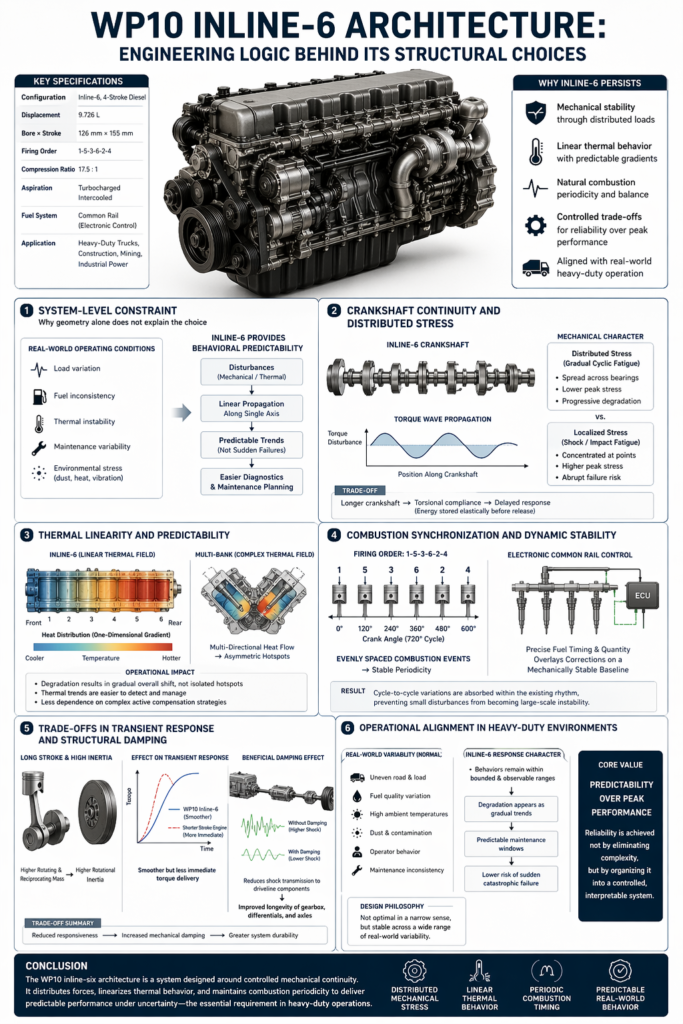
The WP10 engine’s inline-six configuration is often described in simplified terms such as “smooth operation” or “good balance,” but such descriptions fail to capture the actual engineering reasoning behind its continued use in heavy-duty applications. In reality, the architecture is not a stylistic preference but the result of a constraint-driven design process where mechanical stability, degradation behavior, and operational predictability are prioritized over compactness or peak efficiency. To understand why this configuration persists, it is necessary to examine how mechanical forces, thermal behavior, and operational environments interact within a long-stroke diesel system.
1. System-Level Constraint: Why Geometry Alone Does Not Explain the Choice
In heavy-duty diesel applications, engine architecture is not selected based on isolated performance advantages. Instead, it is selected based on how the system behaves under prolonged non-ideal conditions. The WP10 operates in environments where load variation, fuel inconsistency, and thermal instability are not exceptions but normal operating states. Under these conditions, engine behavior is less about peak metrics and more about how deviations evolve over time.
The inline-six layout emerges in this context not because it eliminates mechanical complexity, but because it organizes that complexity in a linear and therefore more interpretable form. When disturbances—whether mechanical or thermal—are constrained to a single axis, their propagation becomes easier to anticipate. This predictability is more valuable in fleet operations than marginal gains in efficiency, because it allows maintenance decisions to be based on trend behavior rather than sudden failure events.
2. Crankshaft Continuity and the Nature of Distributed Stress
The most defining structural element of the inline-six configuration is the crankshaft, which in the WP10 is sufficiently long to introduce non-trivial torsional dynamics. While combustion events are evenly spaced and inherently balanced at the primary level, the crankshaft acts as a continuous elastic medium rather than a rigid connector. This means that torque input from each cylinder does not simply sum linearly but propagates along the shaft as a wave-like disturbance.
In practical operation, this creates a system in which stress is distributed rather than localized. Instead of concentrating mechanical load at specific points, the inline configuration spreads it across multiple bearings and along the shaft length. This distribution does not eliminate stress; it changes its character from localized shock loading to gradual cyclic fatigue. The importance of this transformation lies in how failure develops. Localized stress systems tend to fail abruptly when thresholds are exceeded, while distributed stress systems tend to degrade progressively.
However, this same structural continuity introduces a trade-off. The longer crankshaft increases susceptibility to torsional compliance, meaning that under sudden load changes the system does not respond instantaneously. Instead, energy is temporarily stored within the shaft before being released, creating a measurable delay between combustion input and mechanical output. This delay is not an inefficiency in the traditional sense but a structural consequence of energy propagation through an elastic medium.
3. Thermal Linearity and System Predictability
Beyond mechanical behavior, the inline-six arrangement also defines the thermal structure of the engine. Because all cylinders are arranged along a single axis, heat generation follows a linear spatial distribution. This results in a thermal field that is fundamentally one-dimensional rather than multi-directional.
In multi-bank engine configurations, thermal behavior is more complex because heat flows interact across separate structural regions, often creating asymmetric temperature zones. These zones require active compensation through cooling system design and electronic control strategies. In contrast, the WP10’s linear configuration simplifies this behavior into a continuous gradient along the engine block.
The significance of this simplification is not improved cooling efficiency but reduced uncertainty in thermal response. When cooling conditions degrade—due to dust accumulation, radiator blockage, or airflow reduction—the system does not typically develop isolated hotspots. Instead, it exhibits a gradual shift in overall equilibrium temperature. This type of degradation is structurally easier to detect and manage because it manifests as a continuous trend rather than an abrupt anomaly.
4. Combustion Synchronization and Dynamic Stability
The inline-six configuration also defines the temporal structure of combustion events. With evenly spaced firing intervals, combustion forces are distributed in a periodic sequence that remains stable even when individual cycle variations occur. In WP10 systems using electronically controlled common rail injection, this temporal structure is further refined through precise fuel delivery timing.
However, it is important to note that electronic control does not fundamentally alter the mechanical behavior imposed by geometry. Instead, it overlays a correction layer onto an already stable firing sequence. The inherent advantage of the inline-six layout is that it provides a stable baseline onto which control strategies can be applied without destabilizing the underlying mechanical rhythm.
This combination of mechanical periodicity and electronic modulation results in a system where small variations in combustion do not escalate into large-scale dynamic instability. Instead, they are absorbed within the existing temporal structure of the engine cycle.
5. Trade-Offs in Transient Response and Structural Damping
While the inline-six configuration provides stability in both mechanical and thermal domains, it introduces inherent limitations in transient response behavior. The mass distribution of a long crankshaft and reciprocating assembly increases rotational inertia, which affects how quickly the engine can respond to sudden changes in load demand.
In practical terms, this means that torque delivery in WP10 engines tends to be smoother but less immediate compared to shorter or more aggressively tuned engine architectures. However, this characteristic is not simply a performance limitation. It also functions as a form of mechanical damping that reduces shock transmission to downstream components such as gearboxes and differentials.
By smoothing transient torque fluctuations, the system reduces peak stress events in the driveline. This has a direct impact on the longevity of connected mechanical systems, particularly in applications involving frequent load changes such as construction transport or mining operations.
6. Operational Alignment in Heavy-Duty Environments
When the inline-six architecture is evaluated within the context of actual deployment conditions, its design logic becomes clearer. Heavy-duty engines are not operated under controlled laboratory conditions but within systems where maintenance consistency varies, environmental conditions fluctuate, and operational loads are unpredictable.
In such environments, the most valuable engine characteristic is not maximum efficiency but behavioral predictability. The WP10’s inline-six configuration supports this by ensuring that mechanical, thermal, and combustion behaviors remain within bounded and observable ranges even as operating conditions degrade.
This alignment between structural behavior and operational reality explains why the architecture persists despite the availability of more compact or theoretically efficient alternatives. It is not selected because it is optimal in a narrow sense, but because it remains stable across a wider range of real-world variability.
Conclusion
The WP10 inline-six engine architecture should be understood as a system designed around controlled mechanical continuity rather than isolated performance optimization. Its value does not lie in eliminating complexity but in structuring that complexity in a way that produces predictable behavior under uncertainty. Mechanical forces are distributed rather than concentrated, thermal behavior is linear rather than multi-nodal, and combustion timing is periodic rather than irregular.
Each of these characteristics introduces trade-offs—longer structural components, reduced transient responsiveness, and increased inertial effects—but these trade-offs are not design flaws. They are the necessary conditions for achieving stability in environments where ideal operating assumptions do not hold.
From this perspective, the WP10 inline-six configuration is not simply an engine layout. It is a controlled framework for managing mechanical uncertainty in heavy-duty operation systems.